A Forthcoming Lunar Collision
The Moon, a celestial body scarred by millennia of impacts from asteroids and meteoroids, is poised to experience another collision. This time, the impactor is not a natural phenomenon but a man-made object: the upper stage of a SpaceX Falcon 9 rocket. Scientists anticipate this event will occur on Wednesday, March 4, 2022, at approximately 06:35 GMT, with the rocket component traveling at an estimated speed of 2.43 kilometers per second (about 5,400 mph).
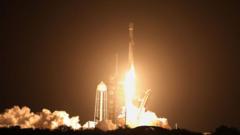
This particular Falcon 9 rocket was part of a joint US and Japanese mission launched last year, designed to transport lunar landers and scientific equipment to the Moon. While parts of the Falcon 9 are engineered for reusability and return to Earth, other sections are jettisoned into space, where they can remain in orbit or, as in this case, eventually collide with another celestial body. The object in question, the rocket's upper stage, is roughly the size of a five-story building and has an Earth-equivalent weight of at least 4,000 kg (8,800 lbs).
Tracking the Trajectory and Anticipated Impact
The US space agency NASA's Centre for Near-Earth Object Studies (CNEOS) confirmed the impending impact after independent astronomers, utilizing public data, identified that a segment of the rocket from a January 2025 launch had inadvertently embarked on a collision course with the Moon. NASA spokesperson Jimi Russell clarified that there is no threat to Earth from this event. He added that NASA would continue to monitor the booster for training purposes and subsequently observe the impact site for scientific research.
Astronomer Bill Gray, credited with the initial discovery of the object's trajectory, predicts that the impact will occur near the Einstein Crater. This location is situated on the part of the Moon that receives daylight and is visible from Earth. Gray estimates that the collision will create a crater exceeding 17 meters (56 feet) in diameter.
Scientific Opportunities and Observational Prospects
The impending collision has garnered significant attention from both amateur and professional astronomers. Dr. Matt Bothwell, a public astronomer at the University of Cambridge, described the event as "something really huge smashing into the Moon." He emphasized that while not dangerous, it presents a unique spectacle. Dr. Bothwell anticipates that the impact will generate a substantial plume of dust, potentially rising 50 kilometers or more into the lunar atmosphere and subsequently spreading sideways.
Due to the Moon's lack of atmosphere and significantly weaker gravitational pull, the impact is expected to be "more impressive than any [similar] explosion on Earth." Without atmospheric resistance, nothing will impede the object's descent, and an estimated million kilograms of debris will be propelled into space. While the naked eye will not be able to observe the impact from Earth, individuals equipped with sophisticated telescopes may be able to discern a flash radiating from the Moon's surface.
Beyond the visual spectacle, Dr. Bothwell highlighted the significant educational potential of this event. He noted that it offers an unparalleled opportunity to study the dynamics of an object hitting the Moon. Consequently, scientists are preparing to monitor the event closely. Large telescopes in the Americas, along with NASA's Lunar Reconnaissance Orbiter and South Korea's Danuri probe, will track the flash, the ensuing dust plume, and the formation of the new crater. Furthermore, a citizen-science initiative is actively recruiting amateur astronomers to film the impact.
By capturing the dust plume in real-time, astronomers aim to transform this accidental crash into a valuable scientific experiment. Observing the quantity of material ejected, its altitude, and its subsequent dispersal will refine existing models of lunar impacts. This data could also provide insights into the composition of the subsurface material at the impact site, as fresh material will be exposed for the first time.
The Growing Concern of Space Debris
Dr. Bothwell also underscored that this collision serves as a cautionary reminder regarding the escalating problem of human-made space debris. "I think more people should be more worried about space debris," he stated, pointing out that "Every single year we put more stuff in orbit." He expressed concern about the potential for a "runaway cascade" if the amount of orbital debris continues to increase, citing instances where satellites collide and fragment into numerous smaller pieces.
According to the European Space Agency (ESA), there are approximately 54,000 objects larger than 10 centimeters currently orbiting Earth. Since the dawn of the Space Age in 1957, humanity has launched an estimated 17,000 tonnes of objects into space. The last recorded instance of a dead rocket impacting the Moon occurred in 2022 when the Chinese Long March 3C upper stage from the 2014 Chang'e 5-T1 mission struck the far side of the Moon. Decades prior, NASA intentionally launched objects into the Moon to gather data for the Apollo missions. This upcoming impact, however, is an unintended consequence of orbital mechanics, offering an unplanned yet valuable scientific investigation into the Moon's geological processes and the broader implications of space junk.