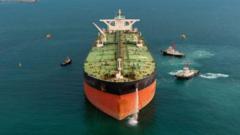
Escalating Risks in Vital Shipping Routes
Experts are sounding the alarm regarding the heightened risks faced by oil tankers navigating the Middle East, asserting that the current situation is the most perilous since the onset of the Iran war. This assessment follows a recent surge in attacks targeting an alternative maritime passage in the region, the Red Sea, which many vessels had been utilizing to bypass the Strait of Hormuz.
The Strait of Hormuz, a critical chokepoint for global energy supplies, has seen its traffic significantly curtailed due to ongoing hostilities. Prior to the conflict, approximately 20% of the world's oil and gas transited through this strait daily. However, recent data from ship-tracking firm Kpler indicates a drastic reduction, with only eight to eleven ships per day passing through over a recent weekend, a stark contrast to the more than 100 daily passages observed before the war. A brief period of increased traffic followed a temporary peace agreement with the United States in early June, but a resumption of hostilities roughly a month later led to a rapid decline in shipping activity.
Matthew Wright, an analyst at Kpler, highlighted the severity of the situation, stating, "In terms of threat to the trade of crude, we're at the worst period that we've been in since this crisis began." He further noted that many vessels are now engaging in "going dark" tactics, switching off their transponders to avoid detection while traversing the Strait of Hormuz.
The Red Sea: A New Hotspot for Maritime Incidents
For a considerable duration of the conflict, some oil shipments from Saudi Arabia had been rerouted through the Red Sea, an alternative corridor situated between the Arabian Peninsula and Northeast Africa. However, this route has recently become a new focal point for threats, with Yemen's Houthi fighters launching a series of attacks on Saudi tankers. The Iranian-backed Houthi militia declared a blockade on Saudi Arabia's Red Sea ports on July 20, and the UK Maritime Trade Operations agency has reported multiple incidents involving ships in the area over the past week.
Wright emphasized the compounding nature of these threats, explaining, "Not only is the ongoing situation in the Strait of Hormuz constraining oil flows, but now a big factor that was helping to balance the market is now also under threat. It's a problem stacked on top of a problem."
Tim Wilkins, managing director of Intertanko, a trade association for tanker owners, echoed these concerns, stating that the industry is "facing a broadening, deteriorating, and increasingly complex security situation." He added, "We now have the high-risk area going up to Saudi Arabian waters and extending into parts of the Red Sea. So that's having another impact on the market, on freedom of navigation as well."
Data from Kpler reveals that on a recent Saturday, 28 commodity vessels passed through the Bab el-Mandeb strait, a crucial point in the Red Sea, with six of them having their transponders deactivated, indicating efforts to evade detection.
Impact on Global Shipping and Oil Markets
While the Houthi threat is primarily directed at Saudi shipping, the overall number of vessels transiting the Red Sea remains at approximately 50% of pre-attack levels. However, the number of ships loading crude oil for export to Asia has plummeted to about four per day, marking the lowest point since the war began, according to Kpler.
Hapag-Lloyd, a major global shipping company, confirmed that some of its vessels continue to use the Red Sea, but a spokesperson stated the company would "monitor developments closely and will adjust the network if circumstances change."
The complexities of the situation extend beyond immediate threats. Even if the Strait of Hormuz were to reopen, a return to normal cargo flows would be a protracted process. "Services have been suspended and ships redeployed elsewhere, so a return to normal flows would most likely take three to four months," a shipping expert noted.
Despite ongoing discussions with Oman, Iran's foreign ministry spokesman, Esmaeil Baqaei, indicated that no immediate agreement to reopen the strait to normal traffic is anticipated as long as US "aggression" persists. Kpler's Wright suggested that while talks with Oman could be beneficial, any lasting resolution would necessitate US involvement, raising concerns that current negotiations might be a "false start" without concessions from either side.
Paradoxically, oil prices experienced a sharp decline following statements from former President Trump indicating a cancellation of planned strikes on Iran, citing the potential for upcoming talks. Brent crude fell by 4.4% to $84.05 a barrel, after an earlier drop of as much as 7.3% to $81.55 a barrel.
Peter Sand, chief analyst at Xeneta, another ship-tracking firm, described the current state of the shipping industry as "back to square one" and in "a terrible state, regardless of which shipping type you're looking at." He concluded, "The alternatives for getting cargo, whether that's hydrocarbons or container shipping, are really not great… it is really still troubling times with no clarity and no change of fortunes within sight."