Overview of Settler Movements in the West Bank
The expansion of Israeli settlements across the occupied West Bank has been accompanied by an increase in activities by various settler groups. These groups are often characterized by a blend of religious and nationalist ideologies, aiming to broaden settlement presence, assert control over the land, and resist any political efforts that might restrict settlement growth. While their structures and operational methods may differ, they generally share common objectives, which include establishing new realities on the ground and, in some cases, displacing Palestinian residents.
These groups frequently benefit from an environment that supports their activities, including political backing, legal frameworks, and on-the-ground assistance, which has facilitated the proliferation of settlement outposts and expansion plans. Several of their leaders are connected to networks of religious figures and right-wing activists who provide ideological and spiritual guidance. Some settlements and outposts also serve as launching points for actions targeting Palestinians.
The Hilltop Youth Phenomenon
Among the more prominent groups is the 'Hilltop Youth,' a decentralized network primarily comprising young Jewish individuals, typically aged 15 to 20. These youths often reside in settlement outposts and agricultural farms situated on hilltops throughout the West Bank. Members of this group come from diverse backgrounds; some have been expelled from educational institutions, while others originate from notable religious families, including those of rabbis and settler leaders.
The emergence of the Hilltop Youth is often linked to a 1998 speech by then-Foreign Minister Ariel Sharon, who encouraged settlers to 'seize the hilltops' to expand control over the land. This directive was widely interpreted as an attempt to disrupt peace processes and the implementation of agreements granting Palestinians greater autonomy. The group's name reflects its strategy of establishing outposts on elevated terrain, thereby creating new settlement facts on the ground that are later often legalized.
Adhering to a stringent religious and nationalist ideology, the Hilltop Youth advocates for Jewish dominion over the West Bank. Their beliefs are influenced by various currents, including Neo-Hasidism and aspects of New Age spirituality. They are also recognizable by their distinctive religious attire, which includes long sidelocks and prominent knitted kippahs or yarmulkes, along with openly displayed tzitzit fringes.
Structure and Activities of the Hilltop Youth
The Hilltop Youth operates without a single unified leadership, instead encompassing multiple settler movements and ideological factions. Following Israel's disengagement from Gush Katif settlements in Gaza in 2005, many members joined the 'Youth for the Land of Israel' movement before branching out into other frameworks. Notable among these are Nahala, led by Daniella Weiss alongside Rabbi Moshe Levinger, and the Torah Core in Hebrew Cities movement, led by Meir Bertler. Other members joined the Land of Israel and Derech Chaim movements, under the leadership of Rabbis Avraham Sigron and Yitzhak Ginsburgh.
The activities of the Hilltop Youth primarily involve actions against Palestinians and the appropriation of land for new settlement outposts. Their methods include occupying hilltops, installing temporary structures with the support of the Israeli army, and expanding control over Palestinian agricultural lands. This often involves uprooting trees, grazing sheep, and preventing Palestinian landowners from accessing their property through intimidation or physical assault.
This group has been associated with numerous incidents targeting Palestinians, including arson of homes and vehicles, vandalism of religious sites and educational facilities, theft or destruction of agricultural produce and livestock, and the use of racist graffiti. According to Peace Now, by the end of 2020, the group had established 170 settlement outposts, reportedly with support from the West Bank Settlements Council. Many of these actions are categorized as 'Price Tag' attacks, which are retaliatory acts that began in 2008 in response to the removal or demolition of unauthorized settlement outposts. The group also receives support from settler organizations, such as Amana, and funding from some regional settlement councils. The Israeli army often provides protection for these outposts, and Israeli authorities have retroactively legalized many of them.
The 'Price Tag' Movement
The 'Price Tag' movement is a covert network of far-right settler groups that emerged in 2008 in response to Israeli initiatives to dismantle unauthorized settlement outposts. The movement's inception is linked to settler leader Gershon Mesika. Its members are predominantly young settlers, many of whom have studied under prominent rabbis such as Yitzchak Ginsburgh, David Dudkevitch, and Yitzhak Shapira. The yeshiva in the settlement of Yitzhar, south of Nablus, is considered a significant stronghold for this network.
The ideology of the 'Price Tag' movement is rooted in the belief that any Israeli action against settlement activity, or any Palestinian attack, warrants retaliatory actions against Palestinians and their property. The goal is to increase the 'price' of such actions, hence the movement's name. Its members adhere to a hard-line religious and nationalist perspective that, in some instances, advocates for the expulsion or killing of Palestinians. This is often reflected in slogans left at attack sites, such as 'Death to the Arabs,' 'Revenge,' and 'Price Tag.' The network has been connected to hundreds of attacks against Palestinians and their property, including arson of homes and vehicles, attacks on mosques and churches, vandalism of schools, the destruction of olive trees, and assaults on Palestinian farmers.
Emergence of 'Guard Teams'
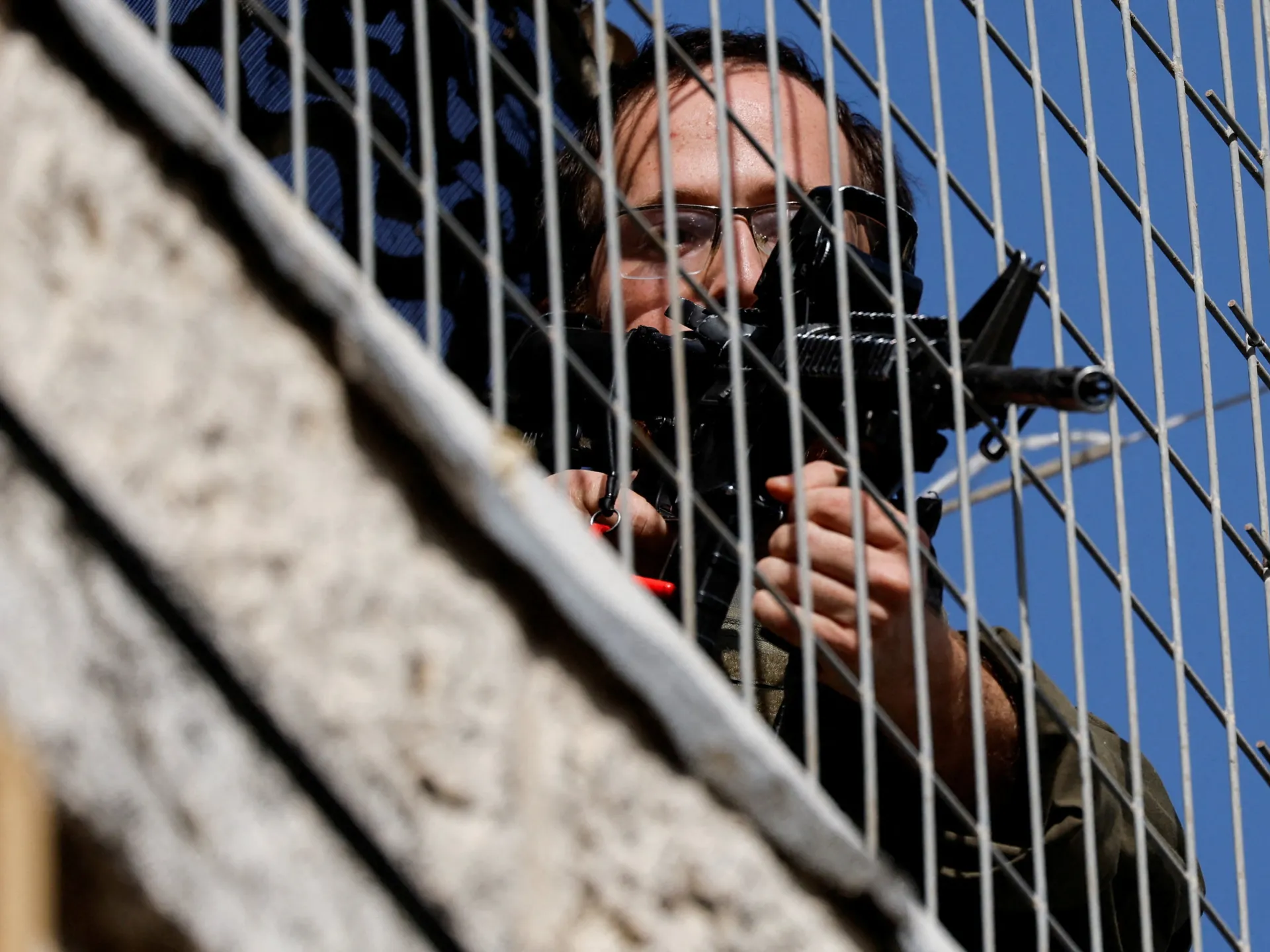
Following the events of October 7, 2023, so-called 'Guard Teams' began to appear. These teams consist of settlers wearing military uniforms and emerged after the Israeli government expanded security formations within settlements and supplied thousands of settlers with weapons. This initiative, spearheaded by National Security Minister Itamar Ben-Gvir, was presented as a measure to enhance settlement security. This system also incorporates rapid response units, regional garrison battalions, and security coordinators, all contributing to the civilian-military security apparatus within West Bank settlements.
Human rights organizations, including the Israeli group B'Tselem, have reported that this expansion has led to increased involvement of settlers, often in military uniforms or carrying military-issued weapons, in actions against Palestinians. These actions include shootings, physical assaults, land seizures, property destruction, crop damage, and livestock theft. Some perpetrators were identified as soldiers on leave, reservists, or members of guard teams, while others wore military uniforms despite not being on official duty. Reports by the Israeli rights group Yesh Din highlight the difficulty in distinguishing between these categories in the field, which complicates the determination of legal responsibility for violations. Israeli authorities have faced criticism regarding accountability for members of these formations, as investigative responsibilities frequently shift between the police and military prosecution, often resulting in investigations being closed or remaining unresolved. The increased access to weapons for settlers, coupled with the blurring lines between civilian and military roles, has contributed to an escalation of violence against Palestinians and created a situation where it is increasingly difficult to differentiate between civilian settlers and military personnel. Critics suggest that this model may be inadvertently facilitating settlement expansion in the West Bank.
Impact of Escalating Actions
The rise of these settler groups has coincided with a notable increase in actions targeting Palestinians across the West Bank, both in terms of frequency and geographical scope. These actions are no longer confined to isolated incidents; they have evolved into organized group assaults targeting civilians, property, agricultural land, places of worship, and educational institutions. These are often seen as part of a broader strategy to expand settlement control and establish new facts on the ground.
Documented incidents include killings and shootings, physical assaults, arson of homes, vehicles, and businesses, destruction of crops and trees, land seizures, attacks on Bedouin communities, and the dissemination of racist graffiti on Palestinian property. Palestinian and international human rights organizations have recorded many such incidents occurring under the protection of Israeli forces. Significant incidents attributed to these groups over the past decade include:
- 2014: The abduction and murder of Mohammed Abu Khdeir, a Palestinian child from Shu'fat, Jerusalem, a crime that garnered widespread international condemnation.
- 2015: An arson attack on the Dawabsheh family home in Duma, south of Nablus, which resulted in the deaths of infant Ali Dawabsheh and his parents, Saad and Riham Dawabsheh. His brother, Ahmad, survived with severe injuries.
- 2018: The death of Aisha al-Rabi, whose vehicle was struck by stones near the Za'atara checkpoint, south of Nablus.
- 2022: The fatal stabbing of Ali Hassan Harb while he confronted settlers attempting to appropriate land in Iskaka, east of Salfit.
- 2023-2026: Over 12,000 incidents were recorded across the West Bank, leading to the deaths of 82 Palestinians and the establishment of 200 settlement outposts.
According to the Colonization and Wall Resistance Commission, a Palestinian governmental body, 42 new settlement outposts were established during the first half of 2026 alone.