European Commission President Calls for Unified Border Strategy
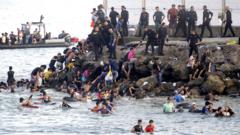
European Commission President Ursula von der Leyen has advocated for a concerted approach to border security in the wake of a substantial migrant surge from Morocco into the Spanish exclave of Ceuta. The incident, which saw tens of thousands of individuals cross into Spanish territory, has underscored the need for more robust external frontier management, according to the EU leader.
Spanish authorities have indicated that approximately 69,500 migrants have since returned to Morocco, a figure surpassing initial projections. The human cost of these crossings has been significant, with 72 fatalities reported on the Spanish side of the border and 11 on the Moroccan side. In response to the developments, EU interior ministers convened an emergency video conference to deliberate on the matter and formulate a collective response.
Internal EU Tensions Emerge
The situation in Ceuta has created considerable strain among the 27 member states of the European Union. While President von der Leyen commended Spanish Prime Minister Pedro Sánchez for his swift management of the crisis in a letter, she also emphasized the necessity for intensified efforts to fortify borders at vulnerable points. Her message highlighted that the events in Ceuta serve as a clear indicator that the EU must enhance its external border defenses.
A notable reaction to the Ceuta crossings came from Italy, which temporarily suspended its participation in the Schengen Agreement with Spain. The Schengen area, known for its elimination of internal border checks, encompasses 29 countries and over 450 million people. This move by Italy received support from Finland and Denmark. Czech Prime Minister Andrej Babiš went further, suggesting a temporary suspension of Spain's Schengen membership altogether.
In response to these criticisms, Prime Minister Sánchez expressed significant concern regarding the stance of certain European governments. He clarified that Ceuta is not part of the Schengen area, thereby distinguishing the incident from Schengen-related concerns. Sánchez noted that while many European nations had offered 'support and solidarity,' others had chosen to criticize Spain, attributing their actions to 'prejudice, fake news, ignorance, or political interest.'
A Shared Responsibility for External Borders
President von der Leyen's communication to the Spanish Prime Minister underscored the principle that 'the protection of all our external borders is a shared European responsibility.' She called for 'vigilant monitoring and the use of physical barriers where needed,' reinforcing the idea of a comprehensive and coordinated approach to border management.
The video conference held by interior ministers was intended to facilitate a review of the 'lessons learned' from the Ceuta episode. Von der Leyen stressed that the challenges posed by irregular migration demand 'a common European response, united action and solidarity.' She urged the EU to intensify its efforts in five key areas: preventing irregular migration through cooperation with partner countries, bolstering external borders, implementing early warning systems, dismantling human smuggling networks, and improving return processes for those not granted asylum.
Addressing the Root Causes and Future Measures
Prime Minister Sánchez has accused migrant traffickers of exploiting a recent ruling by Spain's supreme court. This ruling reportedly limited the government's ability to immediately deport individuals arriving by sea. This legal context, he suggested, may have been leveraged by criminal organizations. Spain's Interior Minister, Fernando Grande-Marlaska, reported that the situation in Ceuta had largely stabilized. He also indicated that the country is developing plans for an inflatable barrier designed to deter illegal maritime migration.
"From this incident, it is clear that we must do more to further strengthen our borders at critical points." - Ursula von der Leyen, European Commission President
The discussions and proposed actions following the Ceuta events highlight a renewed focus within the European Union on fortifying its external frontiers. The incident has not only brought to the forefront the complexities of migration management but also exposed existing fault lines and differing perspectives among member states regarding shared responsibilities and border control strategies.
As the EU navigates these challenges, the emphasis remains on developing a unified and effective framework that balances humanitarian concerns with the imperative of national and regional security. The path forward will likely involve continued diplomatic engagement, technological advancements in border surveillance, and sustained efforts to collaborate with countries of origin and transit to address the underlying causes of irregular migration.