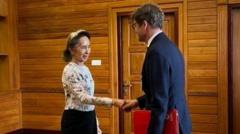
Detained Leader's Condition Verified by Red Cross Visit
Aung San Suu Kyi, the former state counsellor of Myanmar, has reportedly met with a delegation from the International Committee of the Red Cross (ICRC), providing the first verified external contact with her since a letter sent to her son over two years ago. Images released by the military government depict Suu Kyi in good health, alleviating some concerns regarding her well-being.
Suu Kyi was apprehended following the military's overthrow of her government in 2021. She was subsequently handed a 33-year prison sentence on what many observers consider to be fabricated charges. While her sentence has since been reduced, and she has been transferred to house arrest, concrete evidence of her condition has been scarce until now.
International Pressure and Proof of Life Campaign
Despite repeated assurances from the military junta regarding Suu Kyi's health and safety, compelling evidence had not been previously provided. In recent months, her son, Kim Aris, has actively spearheaded an international campaign, pressing for proof of life for the 81-year-old democracy advocate.
The recent visit by an ICRC delegation marks her first confirmed meeting with any non-governmental entity in almost four years. Photographs showing Suu Kyi with the ICRC team, led by representative Arnaud de Baecque, portray her as relaxed and in good spirits. However, specific details about her medical condition or the substance of their discussions have not been disclosed.
"The visit was carried out in accordance with the ICRC's standards and procedures for visiting people deprived of liberty. This included the opportunity to speak with Daw Aung San Suu Kyi in private," the ICRC stated in a brief announcement.
Kim Aris expressed his relief upon learning the news, indicating that the photographs appear authentic and that his mother seemed to be in "good health." He remarked, "It takes quite a lot for me to say that because the military have spread a lot of disinformation and false news over the years, so I've learnt to ignore a large part of it, but on this occasion, I think we can believe what's been said."
Myanmar's Diplomatic Maneuvers Amidst Ongoing Conflict
The current Myanmar government, under the leadership of coup leader Min Aung Hlaing and predominantly military-controlled despite a recent election, is engaged in efforts to mitigate its international isolation. This involves a series of official visits to neighboring countries, aimed at improving diplomatic relations.
Among the primary demands placed upon Myanmar's military leadership by the international community are the cessation of aerial bombardments in areas controlled by opposition forces, the initiation of negotiations to resolve the ongoing civil war, and the release of Aung San Suu Kyi. Thus far, these demands have largely been rejected by the junta. Nevertheless, the recent publication of details concerning the ICRC meeting might suggest a potential willingness on their part to consider the demand for Suu Kyi's release.
The Broader Context: Myanmar's Political Landscape
Aung San Suu Kyi's political journey has been marked by periods of detention and house arrest spanning decades. She rose to prominence as a symbol of democracy in Myanmar, leading the National League for Democracy (NLD) to a landslide victory in the 1990 general election, a result subsequently nullified by the military junta. Her dedication to non-violent resistance earned her the Nobel Peace Prize in 1991.
Following a period of relative democratic transition, the military staged a coup in February 2021, once again seizing power and detaining key civilian leaders, including Suu Kyi. This act triggered widespread protests and a prolonged civil conflict, exacerbating the humanitarian crisis in the country.
The international community has largely condemned the coup and the subsequent crackdown on dissent. Calls for the restoration of democracy and the release of political prisoners, including Suu Kyi, have been consistent from various international bodies and nations. The recent ICRC visit, while a positive step in providing proof of life, does not signify a fundamental shift in the military's stance on broader political reforms or the ongoing conflict.
The situation in Myanmar remains complex, with significant challenges ahead for achieving a peaceful and democratic resolution. The military's willingness to allow external contact with Aung San Suu Kyi could be interpreted as a strategic move to ease international pressure, rather than an indication of imminent political concessions. Observers will continue to monitor developments closely, particularly regarding the demands for an end to violence and the initiation of meaningful dialogue to address the country's profound political and humanitarian crisis.