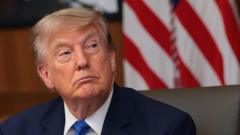
President Trump Encounters Unforeseen Obstacles
In recent days, President Donald Trump has faced a series of complex situations, ranging from domestic legal matters to international diplomacy, which have tested his administration and his political standing. These challenges have emerged not just from traditional political opponents, but, notably, from individuals previously considered among his most loyal supporters. The President's characteristic approach of adhering to his own interpretations of events, often described as creating 'alternative facts,' appears to be encountering increased resistance, even from those within his inner circle.
Legal Setback: The Reflecting Pool Incident
One prominent instance of this shifting dynamic involved the federal prosecution of David Hearn for alleged damage to the Reflecting Pool near the Washington Monument. Initially, the Trump administration had championed the narrative of vandalism. However, US Attorney Jeanine Pirro, a former Fox News personality and a vocal supporter of the President, ultimately decided to drop the felony charges. Her decision, outlined in a 20-page court filing, stated that the damage was a result of a 'botched installation' rather than intentional destruction. Pirro attributed the initial decision to prosecute to misleading information from the Department of Interior. This move presented a direct contradiction to the President's public stance, which had enthusiastically endorsed the vandalism explanation. President Trump, in turn, publicly criticized Pirro's decision, remarking on Truth Social and from the Oval Office that 'She folded like an umbrella.' This episode highlighted a rare instance where a key ally prioritized legal evidence over the President's preferred narrative, indicating a potential divergence in their approaches to factual and legal realities.
Political Hurdles: Attorney General Nomination and 'Anti-Weaponisation' Fund
Concurrently, President Trump faced significant political headwinds regarding the permanent nomination of his former criminal defense attorney, Todd Blanche, to the position of Attorney General. Despite Blanche's close relationship with the President, his confirmation encountered unexpected resistance from within the Republican Party. Senators John Cornyn of Texas and Thom Tillis of North Carolina joined Democratic colleagues in opposing Blanche's nomination. Their primary concern revolved around the proposed establishment of a $1.8 billion fund, intended to compensate individuals who claimed to have been targets of politicized government prosecution. Senator Tillis famously dubbed this initiative a 'payout pot for punks,' expressing worries that it could be utilized to compensate individuals involved in the January 6, 2021, Capitol riot. President Trump had previously expressed strong support for this fund, even stating on Truth Social that he would 'push hard' to secure its passage and that 'It will immediately be back on the table, and I will get it done.' However, the political reality in the Senate proved insurmountable. Blanche subsequently acceded to the senators' demands, issuing letters that satisfied their concerns. While President Trump publicly downplayed his awareness of Blanche's concessions, stating he 'didn't look at' the documents, the incident underscored the limits of presidential influence even among loyalists when faced with substantial legislative opposition.
International Diplomacy: Stalled Iran Negotiations
Beyond domestic challenges, President Trump's administration continues to grapple with the complexities of the ongoing conflict with Iran. This situation, unlike the domestic issues, holds significant public interest and directly impacts his administration's broader foreign policy objectives. Recent developments included a claim by President Trump that he had called off a significant military strike at the behest of Iranian officials and Arab intermediaries, followed by his condemnation of what he termed Iranian 'duplicity' after Iran denied any new direct negotiations. He posted on Truth Social, lamenting, 'They ask for a meeting, some would say 'beg', talks begin, with more scheduled in the immediate future, and they say, openly and proudly, that they're not having any discussions.' While Iranian officials have historically been accused of misrepresenting diplomatic efforts, President Trump has also, at times, been criticized for readily accepting their assurances, leading to premature declarations of diplomatic breakthroughs. US officials, speaking to CBS News, indicated that no 'new' or novel negotiations with Iran were planned, and an Iranian official clarified that their only current talks were with Oman concerning shipping in the Strait of Hormuz. This recurring pattern of stalled progress and conflicting narratives has contributed to growing public dissatisfaction with the conflict, with polls indicating a decline in the President's approval ratings and concerns about his ability to achieve his stated war goals.
Public Opinion and Future Political Landscape
Recent public opinion surveys highlight the broader impact of these challenges on President Trump's popularity. An Associated Press poll, along with similar findings from CNN, Quinnipiac, and YouGov, places his approval rating at 33%. This figure is comparable to or lower than his ratings following the Capitol riot and stands above only Richard Nixon among second-term US presidents in modern American history. Despite these numbers, President Trump has consistently dismissed such surveys as 'Fake News Media' fabrications, asserting on Truth Social that his 'REAL Polling Numbers... are the best they have ever been.' As the congressional midterm elections approach in three months, the ultimate measure of his political fate will be determined at the ballot box. While President Trump has demonstrated surprising resilience in past elections despite challenging poll numbers, any significant struggles for the Republican Party in the upcoming midterms could present yet another undeniable reality that he will ultimately be compelled to confront.