The Rise of the Digital Lifeline
In the Gaza Strip, where economic hardship and displacement are widespread, the digital economy is emerging as a critical avenue for employment and financial stability. Thousands of young Gazans are actively pursuing roles in technology, utilizing their skills in software engineering, coding, and design to connect with international clients. This trend offers a vital lifeline for individuals and families struggling to rebuild their lives amidst ongoing conflict and devastation.
Walaa Volidis, a 24-year-old Palestinian software engineer, exemplifies this resilience. Despite living in a tent in central Gaza with her displaced parents and four younger siblings, she remains committed to her professional development. Walaa regularly engages with mentors in Silicon Valley, striving to keep her skills sharp in the rapidly evolving field of artificial intelligence. "When the war started, I lost everything: my job, my university, even some of my family members. My sisters were injured," Walaa recounts. Despite the profound personal toll, she prioritized finding work, viewing it as a crucial step towards regaining control and purpose. "I have my main goal every single day to go to work, to finish my tasks. If you stop or cry about your situation, you will not do anything," she states, highlighting the determination shared by many in Gaza's burgeoning tech community.
Economic Challenges and the Search for Solutions
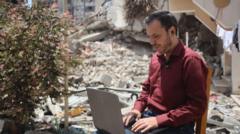
The economic landscape in Gaza is dire, with the United Nations reporting an unemployment rate exceeding 80%, a stark increase from 22% before the recent conflict. The majority of Gaza's two million residents rely heavily on humanitarian aid for survival, with limited opportunities for secure employment and decent wages. In this challenging environment, humanitarian organizations like Mercy Corps view online work, particularly freelancing for international clients, as one of the most promising avenues for economic recovery. Nicole Hark from Mercy Corps emphasizes this point, describing it as a "digital lifeline." She explains, "This idea that if you have a laptop, if you have a working internet connection, you can work and have an income, it's really critical to help people go back to work. They don't want to be dependent on aid."
Prior to the latest conflict, Gaza boasted a developing tech sector. Organizations like Gaza Sky Geeks, founded in 2012 by Google and Mercy Corps, played a significant role in fostering tech startups, offering coding courses, and providing guidance on accessing international markets. While two of its three hubs were destroyed during the conflict, new co-working spaces have emerged across Gaza. These facilities, often powered by generators and solar panels, provide more stable internet connections and power supplies, addressing critical infrastructure deficiencies. Approximately 75% of Gaza's telecommunications networks have been damaged or destroyed, and its power system has suffered near-total collapse, making these co-working spaces indispensable for tech workers.
Overcoming Obstacles: Payment and Infrastructure
Tarik Zaeem, a 44-year-old freelance programmer, illustrates the profound impact of the conflict on established professionals. Formerly a chief technology officer for a local firm, Tarik is now rebuilding his career from scratch. "When I work on my laptop, I forget everything. I forget what's happened," he shares from a co-working space in Gaza City. He has successfully developed mobile applications for clients, including a booking app for a barber and a valet parking app for a Saudi client. However, securing payment remains a significant hurdle. Few bank branches are operational, cash is scarce, and Palestinians face stringent international banking restrictions, often preventing them from registering with most digital payment platforms. Many resort to routing payments through relatives abroad or relying on local brokers who charge substantial fees, sometimes reducing Tarik's earnings by half. This financial leakage significantly diminishes the benefits of his hard work, leaving him with just enough for basic necessities.
The challenges extend beyond financial transactions to the very tools of their trade. Mahran Bayed, another Gazan tech worker, faces the additional difficulty of a damaged laptop screen, a consequence of the ongoing conflict. He must carry an external display to work effectively. While local workshops attempt to repair computers using salvaged parts, the Israeli defense authority Cogat classifies computers and their components as "dual-use" items, restricting their import. This classification, intended to prevent items from being used for military purposes, inadvertently stifles the tech sector's ability to acquire essential equipment for civilian use.
Resilience and Future Aspirations
Despite the constant threats and infrastructural deficiencies, Gaza's tech workers demonstrate remarkable resilience. Mahran Bayed, who lost his home, office, and equipment, now finds purpose in freelancing, creating mobile apps, websites, and advertisements. "From Gaza, I can collaborate with teams in completely different [parts] of the world and contribute with people I've never met," he explains, highlighting the global connectivity that technology affords. He also recounts the grim reality of needing to reassure prospective clients about project delivery, even in the face of extreme personal risk. "Once we get a job for IT that needs like three to four months, we are trying to say to this customer: 'Please know that everything will be online, if we get killed, you will have your work,'" he states, underscoring the profound uncertainty under which they operate.
Walaa Volidis's journey reflects both the personal tragedy and the professional aspirations common among her peers. She recently secured a full-time position with a Dubai-based firm, a testament to her dedication and the support she received from organizations like TAP, a Palestinian-Dutch social impact startup. Her immediate goals include improving her family's quality of life and securing medical evacuation for her younger sister, who suffers from lymphedema due to trauma injuries. Walaa also harbors personal ambitions, aiming for a scholarship to pursue further education abroad. While Gaza's broader recovery remains stalled, the determination and ingenuity of its tech workers offer a compelling glimpse into a potential future where digital innovation can provide opportunity and hope, even in the most challenging circumstances.